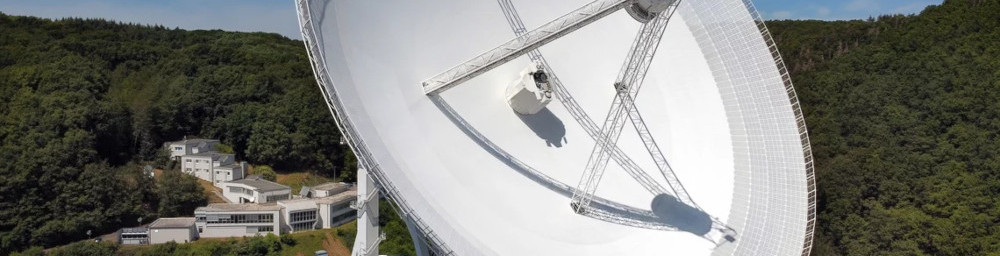

The Max Planck Institute for Radio Astronomy (MPIfR) is a world-leading institute in radio astronomical research. The institute’s approximately 300 international staff members and students conduct fundamental astronomical research consisting of projects and collaborations with observatories all over the world as well as in space. The institute carries out state-of-the-art research and development activities in its high-tech laboratories. It operates the 100-m-telescope in Bad-Münstereifel-Effelsberg as well as the APEX sub-millimeter telescope at an altitude of 5,100 m in the Atacama Desert in Chile and is currently in the process of expanding the MeerKAT+ telescope in South Africa. Furthermore, we support radio astronomical receiver systems and HPC systems at sites all over the world.
To strengthen the MPIfR Backend Development Group (BDG) we are looking for a
Software Engineer (m/f/d)
The BDG develops and operates high-performance, software-based data analysis systems via GPU and FPGA-supported HPC clusters at large international research facilities such as Effelsberg, SKA and MeerKAT. The systems developed by the BDG are based on state-of-the-art methods of high-performance computing and real-time signal processing, which will enable reliable process data rates in the range of 10–100 Tbit/s in the future.
As part of existing and future projects, you will take independent responsibility for the technical development, organization, and documentation of subprojects. You will furthermore have the opportunity to develop, implement, and test your own ideas. Close collaboration and the exchange of skills, experiences, and tools within the work group and the division are an essential part of your daily work.
Your tasks:
- Design, implementation, and continued development of high-performance scientific software for real-time data processing on HPC systems
- Collaboration in and technical responsibility for software-centered subprojects (design, implementation, testing, documentation)
- Integration, commissioning, and testing of software components in the laboratory and at observatories
- Analysis and optimization of performance, scalability, and system stability
- Working in close collaboration with scientists, engineers, and international partner institutions
We expect:
- Completed university degree (Master's) in computer science, information technology, physics, or a closely related natural science or engineering field; a completed PhD is an advantage
- Very good knowledge of software development with C++ and Python, as well as experience in GPU programming (e.g., CUDA or comparable frameworks)
- In-depth understanding of digital signal processing (time- and frequency-discrete systems, filters, spectral analysis, real-time processing)
- Experience working with larger, collaboratively developed code bases (including version control, structured development processes)
- High interest in experimental research and motivation to independently familiarize yourself with new technical subjects
- Very good written and spoken English skills for work in international teams; German skills are an advantage
- Willingness to work in the laboratory and at national and international observatories
- Willingness to travel for projects and to participate in conferences
Furthermore, we expect a keen interest in and curiosity about technical and physical subject matters as well as a talent for utilizing technical innovations in a goal-oriented manner. Your personal strengths include a high degree of initiative and dedication. You contribute to the team with your proactive, systematic, and precise way of working.
We offer:
- A full-time position with a contract term of up to 3 years
- An international and innovative work environment at a top-tier research institute with health promotion programs
- A modern, well-equipped, and varied workplace with primarily independent, responsible work assigned to you in consultation with the project managers
- Compensation remuneration in accordance with the collective agreement for the public sector (TVöD Bund) including all social benefits and an attractive pension scheme (VBL).